Truly, we live with mysteries too marvelous
to be understood.
How grass can be nourishing in the
mouths of the lambs.
How rivers and stones are forever
in allegiance with gravity
while we ourselves dream of rising.
How two hands touch and the bonds
will never be broken.
How people come, from delight or the
scars of damage,
to the comfort of a poem.
Let me keep my distance, always, from those
who think they have the answers.
Let me keep company always with those who say
“Look!” and laugh in astonishment,
and bow their heads.
Forest and field, sun and wind and sky, earth and water, all speak the same silent language, reminding the monk that he is here to develop like the things that grow all around him.
-Thomas Merton
In celebration of my other new book coming out any day now – Water, Wind, Earth, and Fire: The Christian Practice of Praying with the Elements – I am offering a 5-Week E-Course for part of the Easter season (it actually begins two weeks after Easter Sunday and ends with Pentecost). We often take on a practice for the season of Lent, but for the last couple of years I have pondered what it would mean for me to take on the practice of resurrection during the season of celebration which follows Easter Sunday.
You can find all the details here including weekly reflections and meditation recordings, daily emails with inspiration for your practice, and a signed copy of the book. Register before April 1st and receive a FREE copy of What is Blossoming Within You? as a BONUS!
I am in the midst of the Novena of Grace, a powerful Lenten retreat in everyday life which I coordinate for the Ignatian Spirituality Center. Along with teaching my Lenten E-Course on Benedictine Spiritual Practices and Eyes of the Heart: Photography as Contemplative Practice courses, my days are full of rich reflection. I offer here another slightly revised reflection written last year. Reading my words again I am moved to find they still ring very true in my heart.
__________________________________________
Let mystery have its place in you; do not be always turning up your whole soil with the plowshare of self-examination, but leave a little fallow corner in your heart ready for any seed the winds may bring, and reserve a nook of shadow for the passing bird; keep a place in your heart for the unexpected guests, an altar for an unknown God.
-from Amiel’s Journal, translated by Mrs. Humphrey Ward
At the end of each Novena of Grace liturgy we give people an opportunity to come up and say an individual prayer while holding one of the relics of the Saints I wrote about last week. I have the opportunity to be a relic minister several times over this retreat. Slowly people come forward one by one and stand before me. I place the relic in their hand and place my hands around theirs. There is great intimacy in this act, the warmth of skin touching as they lean toward me and whisper the prayer that is on their hearts. Many pray for family members and friends struggling with illness, some pray for their own clarity and discernment. One young man looks directly into my eyes and says he wants to be healed of his addiction. I look back at him, I hold his hands tightly, and I offer my prayer in return. Many close their eyes to receive this prayer, but he holds my gaze intently. I say that with the whole communion of Saints who stand right there with us, I ask blessings upon him for healing and wholeness in body and spirit. I pray that he be freed from the prison of addiction and experience the promise of life that God desires so deeply for him. I say these words and I mean them as deeply as anything I have ever said. A tear rolls down his cheek. I squeeze his hand, “Amen” we both say and he walks away. His longing has been imprinted on my heart.
Last year one of my readers offered this beautiful poetic image about the relics: “I felt their existence as stones that have fallen into the pond of eternity, the ripples of their falling reaching forward to stroke my soul with their own. I am blessed and able to join in the blessing of others.” Rippling out from the eternal moment, soul encountering soul, blessing upon blessing.
Sometimes I wonder what we are doing when we pray. I question how it all works, we have created such an intricate system for explaining how God responds. But even in the midst of those uncertainties, of this I am sure. The power of being present to another person in the midst of their struggles is of such magnitude, such grace. To extend my reach, to hold the hands of a stranger, to listen intently to the deepest desires of their heart, to offer my own prayers in union with theirs, to create such solidarity in the context of great kindness. I don’t have to know how it all works, except that it matters that I show up and be there along with the great gathering of ancestors who join us in this prayer.
When we arrive in church, we lay everything we bring on the altar — our joys, our griefs, our frustrations, our fears, our celebration. And when we share in the ritual meal, these become mingled. To enter into communion with another means that we each share the burden of what the other carries as well as the lightness of joy. To gather with these fellow pilgrims, means that I must risk a radical vulnerability. I am asked to help carry your sorrow and offer you my gladness and you are asked to do the same for me. I am asked to not try and diminish your sorrow through my gladness, but to allow them all to dwell in that space together, to risk being fully human together.
One of the things I have been reminded of in these days is that the liturgy is a template for our daily living. We gather in community to speak our struggles, to listen to the archetypal stories of our tradition, to share a meal, to reconcile with one another and with ourselves. We lay ourselves at the altar and in the process we are invited to leave room for the unknown God, the God who is far beyond our understanding and who also dwells in the midst of our tears. In Benedictine tradition, one of the vows is conversion, which I take to mean that I have committed myself to a lifelong journey of growing and allowing myself to be surprised by God.
Here on this nine-day pilgrimage, the God of my understanding has shown up again and again with abundance. But also here is the God who breaks through the confines of my imagination – an Unknown God – who shows me that what I believe and don’t believe are of little consequence. What does matter is my capacity for love, and welcoming in the grace offered to me in each moment.
It is the time of the great migrations; wild winged ones fly in ragged formations away from the summer fields of plenty, down from the tundra, up from the tropics, ordinary hearts beating against the winds, resisting the updrafts, into the storms, through the autumnal fogs that hide the hunters and the seductions of rest; wild finned ones turn against the familiar ocean currents to slip through narrow stony channels, leaping against the steepness of the grade, following an ancient invocation of leave and return. Fin and feather, flesh, blood and bone: the earth calls its creatures to leave the familiar, turn again into the unknown; to move steadily and continuously and at great risk toward an invisible goal, expending great energy with the possibility of failure; to live on migratory pathways into the future; the primal logic of survival and regeneration, an ancient summons, nature’s pull against the grain, against all odds, against the reasonable and the safe; reconstituting the world.
-Marianne Worcester
________________
Cloudless Snowfall
Great big flakes like white ashes
at nightfall descending
abruptly everywhere
and vanishing
in this hand like the host
on somebody’s put-out tongue, she
turns the crucifix over
to me, still warm
from her touch two years later
and thank you,
I say all alone –
Vast whisp-whisp of wingbeats
awakens me and I look up
at a minute-long string of black geese
following low past the moon the white
course of the snow-covered river and
by the way thank You for
keeping Your face hidden, I
can hardly bear the beauty of this world.
-Franz Wright
________________
Swans
They appeared
over the dunes,
they skimmed the trees
and hurried on
to the sea
or some lonely pond
or wherever it is
that swans go,
urgent, immaculate,
the heat of their eyes
staring down
and then away,
the thick spans
of their wings
as bright as snow,
their shoulder-power
echoing
inside my own body.
How could I help but adore them?
How could I help but wish
that one of them might drop
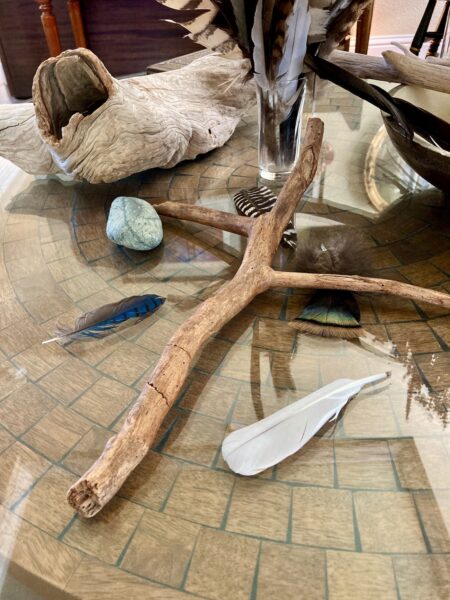
a white feather
that I should have
something in my hand
to tell me
that they were real?
Of course
this was foolish.
What we love, shapely and pure,
is not to be held,
but to be believed in.
And then they vanished, into the unreachable distance.
-Mary Oliver
________________
The photo was received in the Skagit Valley, north of Seattle. The poems were received from readers in response to this Visual Meditation. May your heart be lifted up by the winds this day, may it beat loudly with what you are passionate for.
Last year I wrote this Lenten reflection on meeting the Saints in Walgreens and I offer it here again in a slightly revised version:
____________________________________________
These have been very full days. This Thursday the Novena of Grace begins, which is a nine-day preached retreat in everyday life hosted by the Ignatian Spirituality Center where I work half-time as Program Coordinator. Essentially there are two liturgies each day, midday and early evening, and participants can choose one. It is a truly transformative experience, gathering together for a pilgrimage of the heart in the midst of everyday life. I have been working with the team since September to prepare the theme and movements of each day.
As a part of this service we offer prayers at the end with relics, which are tiny fragments of the remains of Saints, in this case Ignatian ones such as St. Francis Xavier and St. Ignatius of Loyola. The Catholic tradition is nothing, if not incarnational, in touch with the embodiment of human life. I find something so beautiful about this honoring of the physical, tangible connection to the Communion of Saints.
I had to go over to Seattle University where the relics are kept to pick them up. They are housed in small glass and metal cases with the name of the Saint and the relic itself contained within, no larger than the head of a pin. I am responsible these nine days for what are irreplaceable objects. I was handed a small box which held them snugly inside and I placed it gently into my backpack and headed to work. As I walked I was aware of the unusual circumstances of my situation, wandering the streets of Seattle with the remains of the Saints jostling in my backpack.
Along the way I stopped at Walgreens to pick up some Excedrin for a headache that had been building all morning. I walked through the aisles among mascara and foundation, toothpaste and anti-perspirant with the relics at my side. I headed to the pain relief section and stood there in front of the massive array of choices to soothe the aches of human living. I wanted to make my selection quickly, so as to get the relics to their destination. Then I realized in a moment of grace and clarity, what better place for the Saints to be than here in Walgreens? These holy persons who walked the earth and had their own transformations. Ignatius of Loyola knew intimately the profound physical pain of injury and also the doorway it can sometimes offer into something deeper.
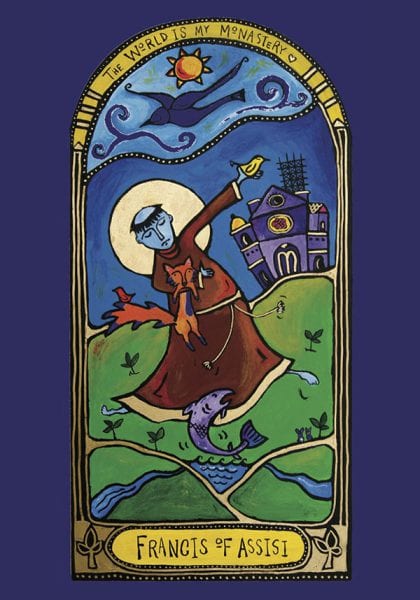
Suddenly they were standing there with me, Francis and Ignatius. They were blessing me with my headache and backpack holding my cell phone, wallet, keys, and sacred bone fragments. They were blessing each bottle of pills, praying that those who purchased them would find relief in both body and spirit. They were blessing the other people who gathered for a brief few moments in that space with me — the elderly man shuffling along slowly looking for a card to express some heartfelt wish to a loved one, the very young girl who was skipping through the aisles asking her tired mother for candy, the tired mother who was just laid off from her part-time work that was keeping ends together and now looking at lipstick colors to grasp at some sense of her own beauty for a moment. I joined them in their blessings, singing them in my heart, showering them on everyone I saw.
I brought my bottle up to the counter. The woman checking out my purchase was cheerful, asking if I had seen their special on eye cream. I wanted to ask her if she had seen the Saints walking through Walgreens that day. I wanted to ask if she knew this place was holy ground.
Terri has created a new blog called Cloaked Monk with her meaningful daily reflections and poetry on the Lenten readings – stop by for a dose of poetic inspiration
Cathy at It’s a Matter of Thyme has been offering an image and haiku each day for Lent as a spare reflection on the beauty of the season.
Jesus took Peter, John, and James
and went up the mountain to pray.
While he was praying his face changed in appearance
and his clothing became dazzling white.
-Luke 9:28-29
Today’s gospel reading is of the Transfiguration of Jesus which is a story of seeing and how beauty becomes a window onto the divine. The burning light that once appeared to Moses in the bush now radiates from Jesus himself.
For Gregory Palamas (a 14th c. Orthodox monk), it was the disciples who changed at the transfiguration, not Christ. Christ was transfigured:
… not by the addition of something he was not, but by the manifestation to his disciples of what he really was. He opened their eyes so that instead of being blind they could see.
Because their perception grew sharper, they were able to behold Christ as He truly is.
We will only see beauty if we practice. To peer into a deeper reality is a metaphysical endeavour, requiring that we ‘see’ with more than merely our eyes, and that we sense with more than merely our natural senses.
Theologian Thomas Dubay writes:
(t)he full experience of a rose requires that we see with our minds the inner energy, the hidden origin, the radical form, and not simply the manifested colors, shapes, and proportions.
Experiencing a rose’s beauty (or a peony, as in the photo) involves more than merely our natural senses, more than our everyday powers of seeing.
The discipline of spiritual practice helps us to cultivate our ability to see below the surface of things, to have a transfigured vision of the world. The desert journey of Lent helps us to strip away what impedes our sight so that “the inner energy, the hidden origin, the radical form” begins to shine through.
What radiance awaits you today if you only take time to look and really see?
My box of books has arrived – I got a sneak peek at my new book at a book festival a week and a half ago and finally have my own copies to hold in my hand and savor. Morehouse Publishing did a fabulous job with the layout of the text – we had various little icons to indicate the different art exercises, some photos, as well as a variety of contributors.
Amazon.com says the books ship in 1-2 months, but rest assured they will be available much sooner. And you can go to the Amazon page to preview some of the content, just scroll down below my face and click on “Table of Contents” or “First Pages.”
I am so very excited! I went out to dinner last night to celebrate with my beloved – one of my practices in life is to celebrate each step along the way. And in less than a month I get to celebrate another step!
I recently completed an incredible journey. I had the privilege of accompanying a group of extraordinarily thoughtful monks and artist from across the US and around the world in an online journey through my newest writing project Way of the Monk, Path of the Artist. When I first announced this class session in late November, I was amazed at and delighted with the hunger for this material. I quickly had to close the winter session and add a spring class, which has also filled, and now we are registering for summer (and that class is 2/3 full with only 8 spots left). More class sessions will be added for the fall soon, although fees will be going up slightly.
I just created a new page on my website with the wonderful feedback I am receiving from participants in the first session. Stop by to read the Praise for the Class and see if the experience calls to you.
The participants in the class showed up fully and embraced whatever I offered to them, giving me the honor of witnessing their own unfolding. Here is a list of links to posts some of them wrote at their own blogs – in no particular order – about their experience:
A visual meditation with images from my travels during the World Congress of Benedictine Oblates in October 2009. The photos were taken in the Vatican City, Rome, Subiaco (Benedict’s Cave), Monte Cassino (Benedictine monastery), and Sant’Anselmo (Primatial Abbey). The music is by Hildegard of Bingen.