Dearest dancing monks, artists, and pilgrims,
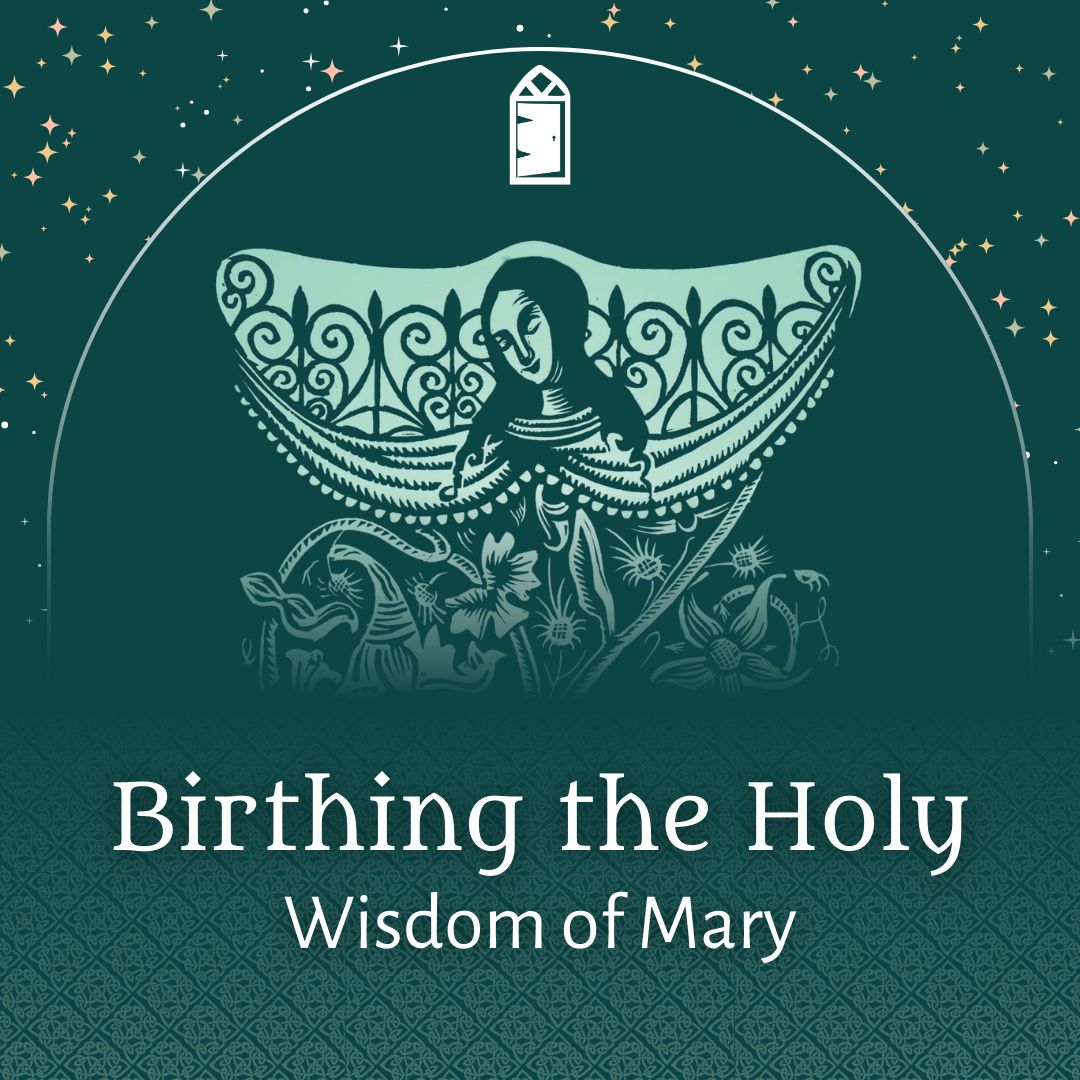
During Advent we consider Mary in a special way, especially her role as the one who birthed Jesus into the world. This image of birthing the holy has long been close to my heart.
Our featured self-study retreat for December is the companion retreat to my book Birthing the Holy in which I explore 31 archetypes and images of Mary. Simon, Jamie, and I will also be leading a contemplative prayer service tomorrow on the theme of Mary as Mirror of Justice.
Here is an excerpt from the book:
Mary appears throughout the Gospels, most notably at the beginning and the end. She is the one who is asked to say yes to the holy birthing and surrenders herself to something far beyond her imagining. She is the one who sits at the foot of the Cross where her son is brutalized and murdered. She stays with him throughout his journey of suffering and into death. It is interesting to consider how much the scriptures focus on her presence at these thresholds of Jesus’s life.
There is the Annunciation, when she is asked for consent, and the Visitation, when two women who are cousins connect over their pregnancies and feel the intimacy of being in this space together. Mary’s poem and song of justice, the Magnificat, has allusions to the Song of Hannah from the Hebrew Scriptures, connecting her to a lineage of wise women. Mary makes a couple of appearances during Jesus’s lifetime, and then again she appears at the end of his life, standing witness at the foot of the Cross with other women, when so many have run away. She was there at the feast of Pentecost. In some traditions, she is the woman in the Book of Revelation: “And a great sign appeared in heaven: A woman clothed with the sun, and the moon under her feet, and on her head a crown of twelve stars” (12:1).
Stories of Mary have been used in various ways to reinforce a certain image of womanhood. The Christian tradition leans heavily on images of male sanctity and masculine divinity; Mary offers us another perspective. She is the embodiment of the sacred feminine, a window into another understanding of how the presence of the sacred can manifest in the world.
Mary has been called the mother of contemplatives as she models the essence of what it is to be an active co-creator and participant in the divine unfolding. She stands with one foot in the earthy, finite world and one in the infinite, luminous realm and bridges that gap in our hearts. Bringing Jesus to birth is less about making up for our sinfulness and more about the glorious revelation that comes when we bring together this wholeness.
She has many titles, including Mother of Mercy and Our Lady of Sorrows, the one who can bear the tremendous weight of our grief. She is the one who knows aching loss and does not run away in the face of its fierceness. There is a tradition of stories of the seven sorrows she had to bear. There is a parallel tradition of Mary’s seven rejoices. She is the container for our struggles and joys. She is the source of compassion. She is the birth mother and the death mother.
Mary as Mother is the expression of infinite compassion and care. She is the experience of love which embraces us when we feel like we may fall apart. We are invited to cooperate with this love and grace always available to us. We are invited to say yes to holy birthing, the way Mary herself did.
Please join us for the self-study version of Birthing the Holy and join us live (online) for our Advent contemplative prayer service tomorrow where we will call on Mary, Mirror of Justice to guide us in the holy darkness.
With great and growing love,
Christine
Christine Valters Paintner, OblSB, PhD, REACE